
Disability Access & The Winter Paralympics in Milano Cortina — As Seen From a Disabled Photographer's Perspective
I was made disabled 4 years ago and got my life together around 10 months later when I set up The Disability Sports Network. My aim is simple: to showcase disabled sports to everyone — not just the disabled who don't do a sport, but to the rest of the community — that we don't just sit at home and watch TV because we are disabled.
My condition is FND (Functional Neurological Disorder) with Fibromyalgia, which limits my walking. I walk with a stick, experience pain in the upper thighs/back, and have intense pins and needles in my feet almost 24 hours per day. So a short walk can make me cry in pain, and some days I cannot go out at all. I have also written a book — An Unexpected Disability — charting what I went through from when I collapsed (Easter Sunday, April 2022) to attending my first Paralympic Games in Paris 2024. I also have a blog called A Photographer with FND with around 80 different entries.
Coming to terms with this disability has been a long process — both physically and mentally. I do not mind being disabled (sounds odd, I know), as it has opened many doors for me and my photography. It has stretched my thinking on how I take photographs, taking a little more risk personally and financially. The result is that when I show my printed photographs or share them online, I get lovely comments about how I captured something people did not know existed — and that is the human spirit of a person with a disability. I don't see the disability straight away; it's what the face tells the reader. Everyone I photograph has a story to tell, and in a blink of an eye I have frozen that moment in time for posterity.
I have now been to a number of large sporting events — the Paralympics in Paris, International Blind Games, Invictus Games, and numerous grassroots and mid-level events in the UK. I now have a good understanding of many new sports, most of which I never knew existed.
Fast Forward to the Winter Paralympics in Cortina, Italy
On paper it's a lovely mountain town serving numerous slopes and skiing activities for all to enjoy. So this seems an ideal location to host the Winter Paralympics — the scenery on the way from Venice airport was beautiful.
My first day, I needed some orientation so I headed to the media centre in town, got a locker and importantly my arm sleeve, without which I cannot photograph.
1st Stop — Curling
Curling had started 3 days early, so it was an ideal time to get a feel for the arena. I got in OK, however the entrance I used required me to walk down 8 or so stairs. As it was early in the day I could manage this (end of day — not a chance). There was no handrail and no one offered help despite my sunflower lanyard and walking stick. When I asked how to get there step-free, they told me I had to walk all the way around the outside of the building. There was a tunnel to the other side, but I was not allowed to use it as my boots were dirty. No indication anywhere of step-free access, no signs, no real help.
2nd Stop — The Opening Ceremony (Verona)
On Opening Ceremony day, I had to travel to Verona — approximately 5+ hours via coach, train, and bus with a police escort. I can say with no doubt my disability needs were met 100% that evening. I was asked if I needed a wheelchair space or just a chair, and the way I was taken from checkpoint to checkpoint was superb. A photo manager I knew from Paris helped me and said I had the best seat in the house — just 2 metres from the stage.
Cortina Snowboard Area
My first idea was to photograph the snowboarding arena. We got a bus with 6 other photographers and were simply dumped at the bottom of a very steep hill, with no assistance and a broken conveyor belt. With an 11kg camera bag and my walking difficulty on hills, I eventually reached the security checkpoint — out of breath, in pain and exhausted.
Despite my photo credentials, they wanted to inspect my bag which was on my back. As I slowly removed it, an impatient guard tried to open a compartment the wrong way — which could have sent a lens rolling down the hill. I had to stop him. Then they wanted to pat me down with a wand. I said STOP — if I am touched unexpectedly it can trigger a collapse due to my FND/Fibromyalgia. Their wand did touch my shoulder blade and that set off a spasm in my left leg. I could not move, screaming in pain. They got me a chair but still tried to inspect my camera bag. I showed them my Disability ID card. They did not seem to care. They gave me no time to recover and just wanted me through the checkpoint as fast as possible.
I sat composing myself for 10–15 minutes. Miraculously my spasms left after 15 minutes — a new record. Then came the big hill up to the ski area with no assistance — not one person from that tent offered to carry my bag. By the time I reached the main area, fellow photographers were already complaining there was nowhere to store kit, no coffee or water provided. I had to pay out of pocket for a bottle of water — and IOC rules required the cap to be removed and discarded at point of purchase (in case it was used as a missile). I was then expected to carry an open bottle of water up a snow hill with my camera bag and walking stick. I had to drink it there and then and was left without water for the rest of the morning on the snow.
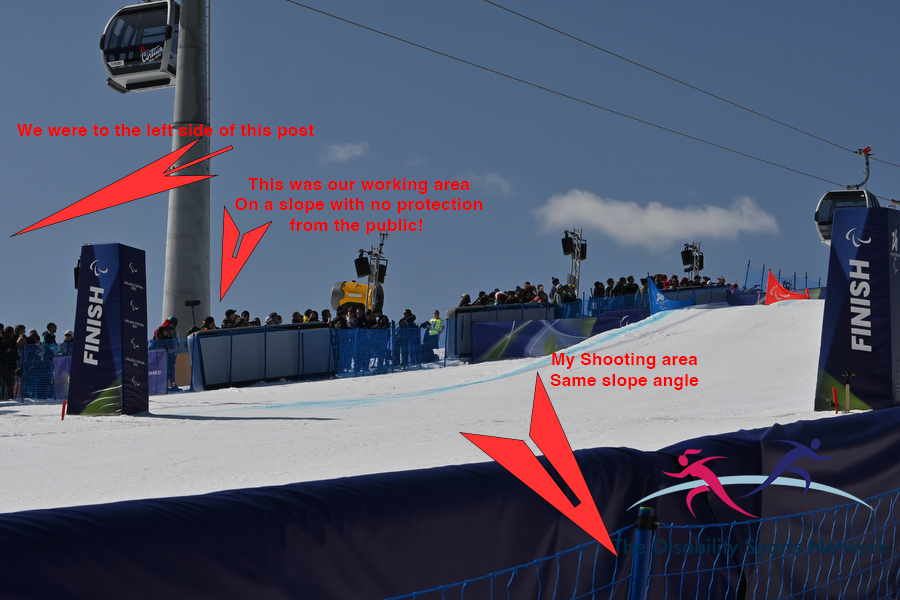
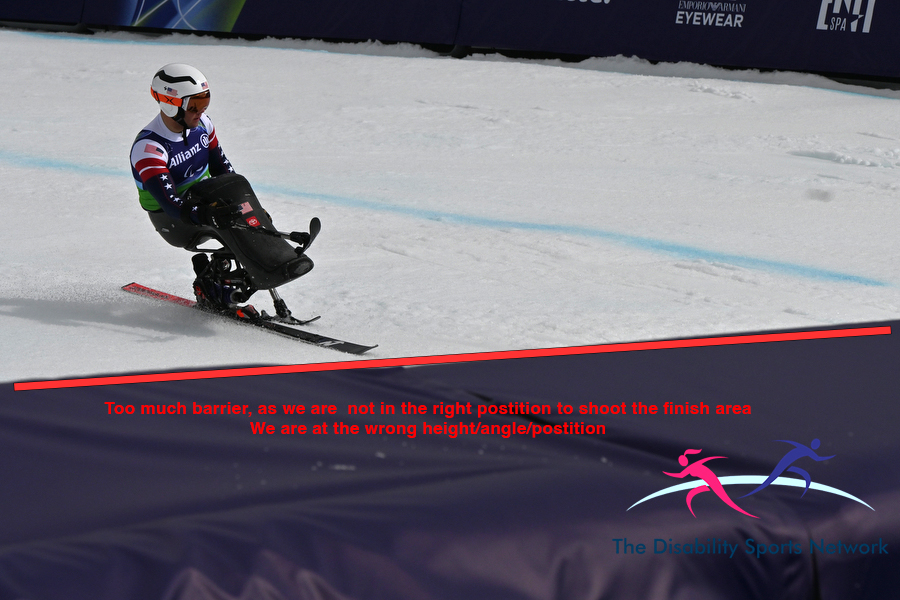
At almost every turn I was denied access. A snowmobile to carry me 200 metres up to the photo area was denied with no reason given. Each new point required radio permission despite my accreditation being valid. When I finally reached a viewing area it was on a gradient — no flat surface to work from, safety barriers creating wedge-shaped obstructions across the bottom of every frame, and nowhere safe to put my bag. Had I slipped, the bag would have gone down the hill. Had I gone down with it, I would have hit a heavy steel lighting structure.
At one point the local photo manager asked if I had crampons for my feet. I did not. No other photographer did either. He shrugged. Going down the snow hill with my camera bag and walking stick, hoping my legs would not give out after the spasms 45 minutes earlier, I eventually got help down a 2-foot drop. Very inaccessible.
When I finally tried to leave, I was told the pickup point was for skiers and helpers only. I asked where the bus back to town was. I was told it was down a steep gravel hill — which I could not manage. After making a fuss and waiting 30 minutes with no seat offered, they arranged an accessible vehicle. Even getting into it, I could not lift my leg to the first step. I tried three times, then manually lifted my own leg. I eventually got back to the media room in town, took extra pain killers, and rested for over 2 hours. According to the official plan there were 3 wheelchair-accessible photo points at the snowboarding area. There were none.
Tofane Skiing Area
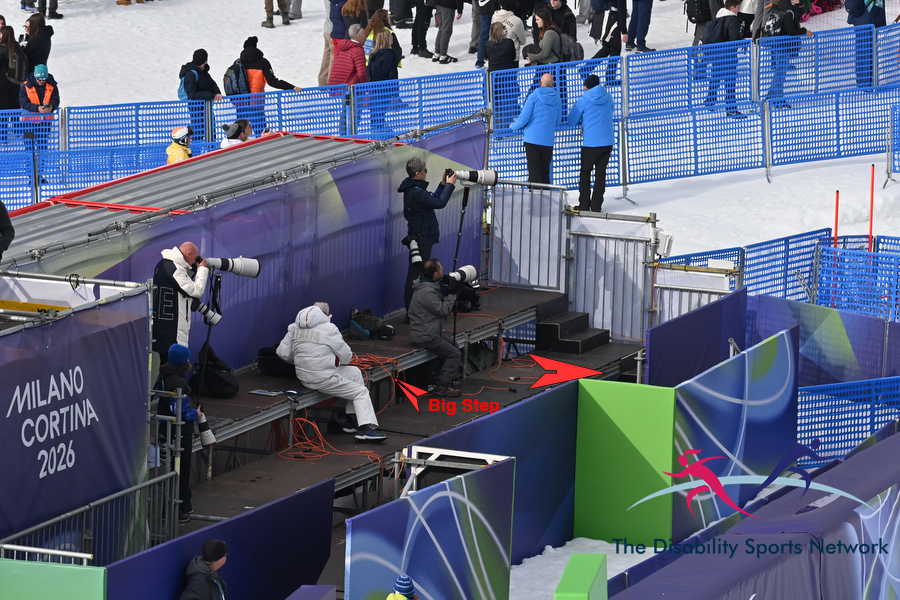
The photo manager came to discuss options — more uphills again. There was one fully accessible viewing position on top of a broadcast structure, but the angle only gave a general overview of the course. Not the eye-catching shots I aim for.
Once off the public area, I was back on snow — too close to a drop on the left. I eventually found a wooden platform, but the steps up were 2-foot climbs each. My legs cannot step that height. I had to shuffle myself and kit up — not elegant, but I managed it. The shots I got from here were fine, but getting there nearly broke me.
I left Tofane bewildered. And I have since heard from many Paralympians that they could not watch their own sports either. No real provisions were made for them. Don't they count any more? Why are we here in the first place?
The Media Centre and Town of Cortina
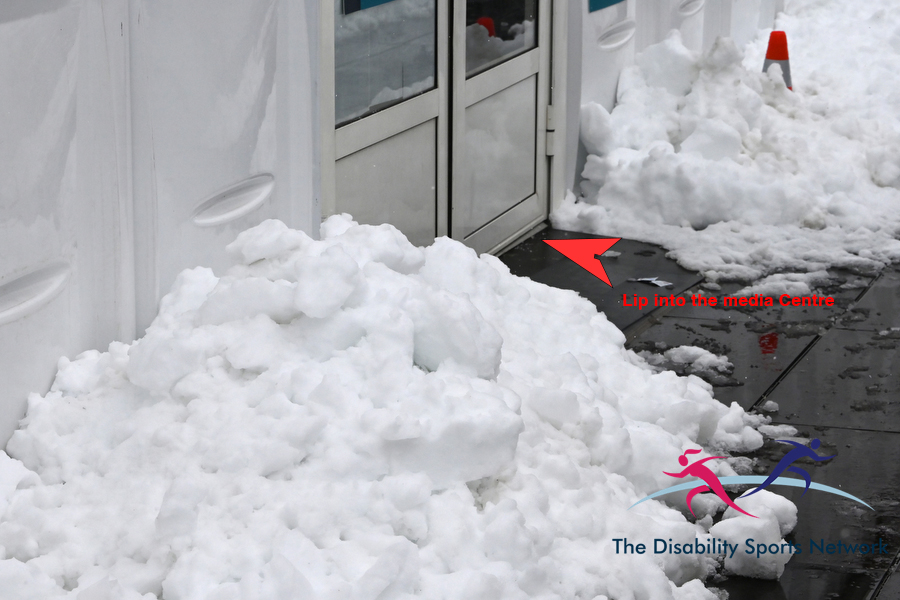
The main media centre in Cortina was on a slope — down a small hill, then up another to the entrance. All doors had bumps of up to 10mm and were manually operated. The cable runs created trip hazards between the lockers. Heavy footfall made the tables shake — enough to spill a coffee — and the space between desks was too small. My walking stick was kicked multiple times. Politeness costs nothing.
Cortina itself is a pretty village, but it is built entirely on a hill. The main path is cobbled. There were no fast food or pop-up options — only sit-down restaurants that did not welcome single diners. Getting anything gluten-free was impossible. Every bus drop-off required walking up or down a steep hill, navigating steps and uneven surfaces — excruciating for anyone with Fibromyalgia and constant pins and needles in their feet.
The Closing Ceremony
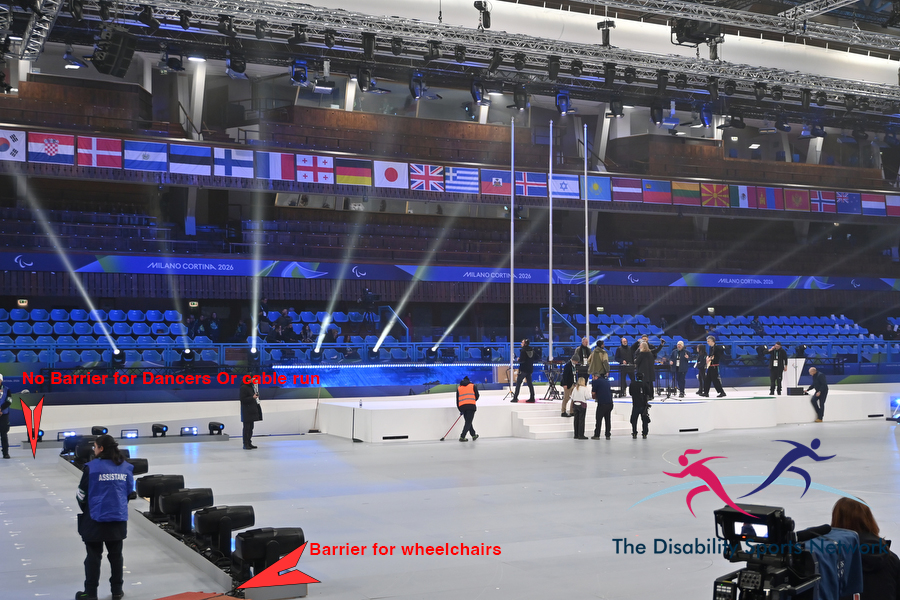
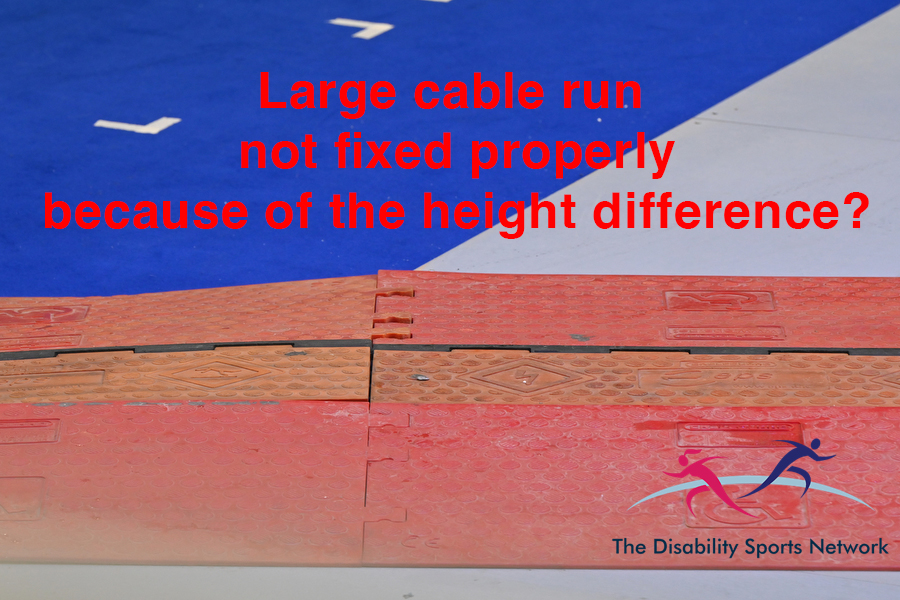
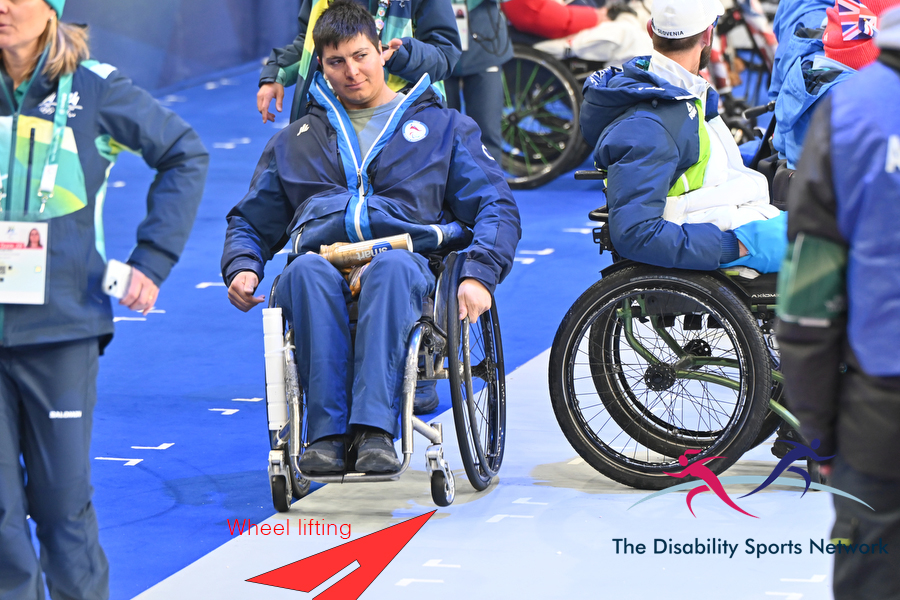
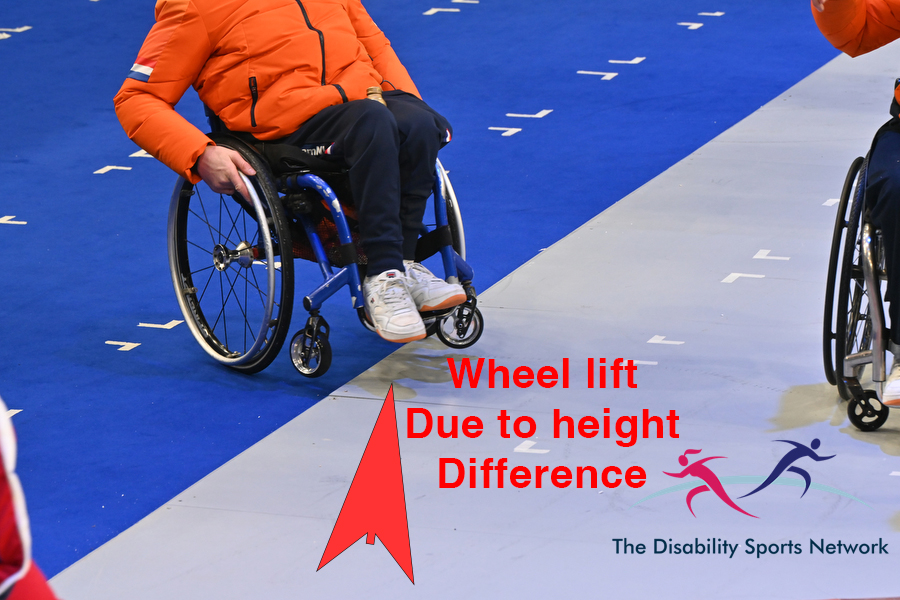
I was assigned an assisted seating area and escorted to my seat — except my guide did not know where the wheelchair or flat entrance was and led me down stairs with no handrail. Lots of blank faces and no handoffs to people who knew what they were doing. The wheelchair users at the front were positioned on boards covering the curling rink, which was fine, however to get there they had to navigate a 4–5mm lip from the carpet. I have photographs of wheelchairs being lifted over it. I also have photographs of a large cable protection barrier that every wheelchair user had to navigate — yet the performers on the same night used a tunnel that bypassed all of it entirely. Basic health and safety. Basic common sense. Whoever designed this layout needs replacing.
Then, during a dance routine, I saw wavy lines in my viewfinder. I checked my second camera — the same. Then I looked up: green lasers were pointing directly across my side of the hall, at the VIP gold ticket holders, at me, and into my cameras. It is proven that high-powered lasers can damage camera sensors — making pixels go permanently white. I turned off my cameras immediately. Nobody had warned us this would happen. I have since reported this to the IPC.
The people behind my area were bouncing the boards I was sitting on. The stress, the lasers, the movement — my FND kicked in badly. My left leg froze in spasm at pain level 8/10. I called for a medic. It took four attempts before someone understood I needed a wheelchair to exit. None of the medics had heard of Fibromyalgia. The wheelchair they brought had solid hard wheels and no cushion. The route out — bumping over scaffolding boards, metal panels and lips every 4–6 feet, down slopes, through potholes in the dark — was agonising. I shouted out in pain at every bump.
The medics were more interested in getting their wheelchair back than in my recovery. Luckily a French lady at the media centre made sure I was OK and let me stay until midnight. The Paralympic helpers primary concern was closing the tent by midnight — not my health. I eventually got a minivan home at 12:30am. The driver helped me up the steep slope to my hotel. I took more pain relief so I could face the journey home the next day.
In Summary
As a disabled person I was utterly disgusted at the lack of accessibility — at the venues, in the town, and even at my hotel, which performed a bait-and-switch, moving me without consent to a property without a lift, with extra hills and stairs, and — critically — no fire detectors anywhere in the building. This has been reported to the IPC Hotel department and the local fire brigade.
I came home far more tired than I should have been due to the inaccessibility of a Paralympic event. There was poor planning at every turn, and when you pointed it out, nothing was done — because the failures were at IPC planning level, not with the individuals on the ground trying to make it work.
Did I get the photos I needed? Yes and no. The positions we were given were almost all terrible unless you were shooting for Getty or AP. The final count was far lower than Paris 2024 — where almost everything was accessible and photographers were right next to the action regardless of sport.
For me, this Paralympic Games was a waste of time and effort for what I got. But more importantly, this account documents that the Paralympic Games failed to deliver an experience — not just for me, but for the athletes who wanted to watch sport, and for the spectators whose views were blocked at almost every venue.
Whoever handled the disability access needs to be removed and replaced with someone who knows what they are doing. It is 2026, not 1926.
In short, the IPC/Paralympic organisation should refund my hotel, travel, expenses and time — for 12 days of an event that failed disabled people at every level.
— Michael Crawford Hick, The Disability Sports Network
Comments
No comments yet — be the first to share your thoughts!

